
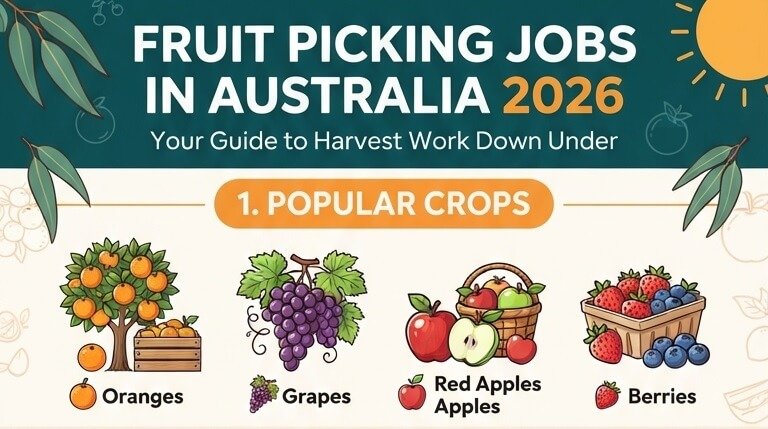
Fruit picking jobs in Australia remain one of the most popular ways for young travellers to earn money while seeing the country. Every year, farms across Queensland, New South Wales, Victoria, South Australia, Tasmania and the Northern Territory hire pickers, packers and farm hands for the harvest, and the work is also the standard route for Working Holiday visa holders who want to extend their stay. This 2026 update replaces the old post with fresh, verified facts: the current Horticulture Award pay rates, the Working Holiday visa rules for subclasses 417 and 462, the 88-day specified-work rule, and the official way to find harvest work now that the old Harvest Trail service has closed.
Fruit picking is seasonal, physical, outdoor work, and it suits people who are fit, reliable and ready to work in the sun. No formal qualification is needed for entry-level picking roles, and many growers provide training on the job. Pay is set by the Horticulture Award, and since April 2022 pieceworkers have a guaranteed daily minimum wage, so a slow day can never leave you below the hourly minimum. Read the pay, visa and application sections below carefully before you travel, and never pay anyone who promises you a picking job or a visa in return for money.
Available Fruit Picking Work:
Farms hire for the same core roles across the harvest season. The exact fruit and the start date depend on the region and the crop, so always confirm the crop, the location and the start date with the grower before you travel.
- Fruit Picker — picking fruit by hand into bins or buckets, working along the rows of an orchard or vineyard
- Fruit Packer — sorting, grading and packing picked fruit in a packing shed
- Farm Hand / Crop Worker — general farm work including planting, pruning, thinning, weeding and crop care
- Harvest Worker — seasonal harvest work across fruit, vegetables and nuts, often moving between regions as crops ripen
Fruit Picking Pay in 2026 — Horticulture Award:
Pay for fruit picking is set by the Horticulture Award (MA000028). The rates below apply from the first full pay period starting on or after 1 July 2026, after the 4.75% Annual Wage Review increase. An adult Level 1 worker — the entry classification for general horticultural work under direct supervision — earns $25.74 per hour as a full-time or part-time employee ($978.10 per week) and $32.18 per hour as a casual worker, which includes the 25% casual loading. Level 2 pays $26.44 per hour ($33.05 casual). Workers move to Level 2 after no more than three months of horticulture-industry experience anywhere in Australia.
Many pickers are paid by piecework — by the bin, bucket or kilogram picked. Two rules protect pieceworkers. First, the piece rate must be set so that a competent pieceworker earns at least 15% more per hour than the minimum hourly rate for their classification. Second, there is a daily minimum wage guarantee: for each day worked, a pieceworker must be paid at least their hourly rate multiplied by the hours worked that day — for a casual Level 1 worker on a 7.6-hour day that is a minimum of $244.57, and for a full-time or part-time Level 1 worker it is $195.62. If piece-rate earnings are higher, the higher amount is paid, and a good day can never be used to offset a short day. Workers with under 76 hours of experience on a task must be paid the same piece rate — there is no lower training rate.
Job Requirements:
- Good physical fitness — you will stand and walk for a full shift, bend, reach and lift, and work outdoors in heat and sun
- Valid work rights in Australia — a Working Holiday visa (subclass 417 or 462) or another visa that permits farm work
- No previous experience is needed for entry-level picking roles — growers train new pickers on the job
- Reliable transport to the farm, as many orchards are outside town centres
- Basic English, written and spoken, and a strong focus on safety, food safety and hygiene
Working Holiday Visa — Subclasses 417 and 462:
Most fruit pickers from overseas work on a Working Holiday visa. Subclass 417 (Working Holiday) is for passport holders of 19 eligible countries, with no annual cap and no education or English test. Subclass 462 (Work and Holiday) covers around 30 partner countries, including India, the United States, China, Vietnam, Indonesia, Singapore, the Philippines, Thailand and Malaysia, and adds requirements such as functional English and a minimum education level. Both visas last 12 months, and you can hold up to three separate visas, for up to three years in total. The first visa must be applied for from outside Australia, and you cannot bring dependent children. Study is limited to four months per visa, and work for one employer is generally limited to six months.
The age limit is 18 to 30 for most countries. For subclass 417 it is 18 to 35 for passport holders of Canada, Cyprus, Denmark, Finland, France, Germany, Ireland, Italy, South Korea and the United Kingdom. From 1 July 2026 the first-visa application fee is AUD 840, and the second and third visas cost AUD 1,000 each. Applicants generally need at least AUD 5,000 in funds, plus the fare out of Australia.
To qualify for a second Working Holiday visa you must complete a minimum of 88 calendar days (three months) of specified work in regional Australia while on your first visa. Fruit picking and plant and animal cultivation count as specified work for both subclasses. For a third visa you need 179 calendar days (six months) of specified work while on your second visa. United Kingdom passport holders are exempt from the specified-work requirement for second and third subclass 417 visas for applications lodged on or after 1 July 2024. The eligible industries differ by subclass, and the work must be in a postcode classified as regional, so check the official postcode list on the Home Affairs website before you start.
Indian passport holders can apply for subclass 462 only, not 417. There are up to 1,000 first subclass 462 visas per programme year for India, and first-time applicants must first be selected in a random pre-application ballot, which costs AUD 25 to register for. For the 2026–27 programme year, registrations ran from 4 to 25 June 2026 and are now closed, and random selections run from 2 July 2026 to 30 April 2027. Selection is only an invitation to apply — it is not a visa grant — and selected applicants have 28 days to lodge their application.
Fruit Picking Seasons in Australia:
The busiest period nationally is November to April, with February the peak month. In summer (December to February) the main crops are cherries, stone fruit, berries, mangoes and melons. Autumn (March to May) brings apples, pears and grapes. Winter (June to August) is citrus and avocado season, and spring (September to November) starts the mango season in the Northern Territory along with strawberries in Queensland. Bananas in Queensland and vegetables are year-round. Key picking regions include Bundaberg in Queensland, the Shepparton and Goulburn Valley region in Victoria, Griffith and Young in New South Wales, Darwin in the Northern Territory, Coffs Harbour in New South Wales and Tasmania for berries and cherries. Seasons shift with the weather, so always confirm the harvest dates with the grower.
How To Apply:
– Step 1: Check that you hold, or can apply for, a visa with Australian work rights — a Working Holiday visa (subclass 417 or 462) is the usual route for travellers. Confirm your visa conditions on the Department of Home Affairs website before you book anything.
– Step 2: Search for harvest work on Workforce Australia Online (workforceaustralia.gov.au), the Australian Government’s official job board, and through your local Workforce Australia provider. Please note that the old government-funded Harvest Trail Services and its 1800 hotline closed on 30 June 2024 — do not rely on old guides that still list them.
– Step 3: Apply directly to growers through their own careers pages — large growers such as Costa Group list picking, packing and crop roles on their websites — and check reputable job boards, working hostels and local harvest groups in the region where you want to work.
– Step 4: Contact the grower or labour-hire provider, confirm the crop, location, start date, pay basis (hourly or piecework) and accommodation, and keep a written record of what was agreed.
– Step 5: Keep your payslips and proof of each day worked. If you plan to use the work for a second Working Holiday visa, you will need evidence of your 88 days of specified work, so keep every record from day one.
Important Documents to Bring:
- A valid passport
- Your visa grant notice or other proof of your Australian work rights
- An updated CV, even a short one, listing any farm or outdoor work you have done
- Bank account details, so the grower can pay your wages
- Sun protection, a hat, sturdy shoes and work clothes suitable for a full day outdoors
Frequently Asked Questions:
Q1. How much do fruit pickers earn in Australia in 2026?
Under the Horticulture Award, an adult Level 1 worker earns $25.74 per hour as a full-time or part-time employee and $32.18 per hour as a casual worker, from the first full pay period on or after 1 July 2026. Pieceworkers must be paid so that a competent pieceworker earns at least 15% above the hourly rate, and every pieceworker has a daily minimum wage guarantee — at least the hourly rate multiplied by the hours worked that day.
Q2. Do I need experience to get a fruit picking job?
No. Entry-level picking roles need no previous experience, and growers train new pickers on the job. You do need to be physically fit, ready to work outdoors all day, and you must already hold valid Australian work rights.
Q3. What is the 88-day rule for a second Working Holiday visa?
To qualify for a second Working Holiday visa you must complete at least 88 calendar days of specified work in regional Australia while on your first visa. Fruit picking counts as specified work for both subclasses 417 and 462. For a third visa you need 179 calendar days of specified work while on your second visa. United Kingdom passport holders are exempt from this requirement for applications lodged on or after 1 July 2024.
Q4. Can Indian citizens apply for a Working Holiday visa for fruit picking?
Yes, through subclass 462 only. India has up to 1,000 first subclass 462 visas per programme year, and first-time applicants must be selected in a random pre-application ballot. Registrations for 2026–27 ran from 4 to 25 June 2026 and are now closed, with selections running from 2 July 2026 to 30 April 2027. If you were not selected, you cannot lodge a first 462 application for this programme year.
Q5. Is the Harvest Trail service still running?
No. Harvest Trail Services and its information hotline closed on 30 June 2024. The official replacement route is Workforce Australia Online (workforceaustralia.gov.au), the Australian Government’s job board, plus local Workforce Australia providers. Many older guides still list the old service, so check the date of anything you read.
Fruit picking can be a great way to fund a trip around Australia and to qualify for a longer stay, but only if the pay and the visa rules are right. Check the Fair Work Ombudsman and Home Affairs pages before you go, keep every payslip and work record, and never pay anyone for a job or a visa.

