
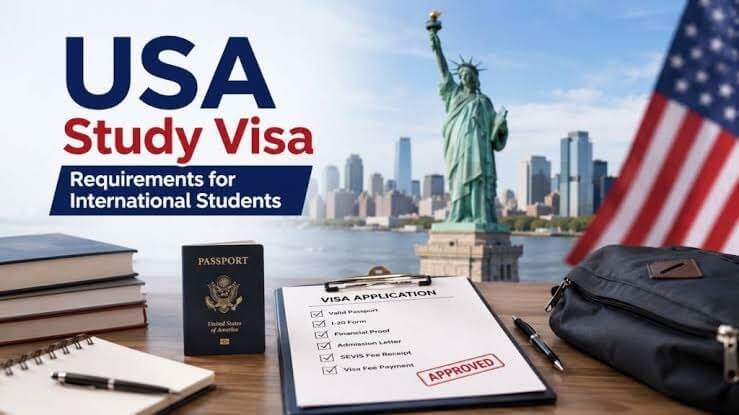
The United States remains one of the most popular study destinations in the world, with thousands of international students joining American universities, colleges and language programmes every year. The main student visa is the F-1 visa, for full-time academic study, while the M-1 visa covers vocational study and the J-1 visa covers exchange programmes. This guide explains the F-1 route step by step in 2026: admission, the I-20 form, the two government fees, the DS-160 application, the interview, and the documents to carry.
Getting a student visa is a process with a fixed order, and skipping a step causes delays. First you must be admitted by a school, then you pay the SEVIS fee, then you complete the visa application form and pay the visa fee, and only then do you attend the interview. Fees and rules change, so always re-check the official U.S. government pages linked in the steps below before you pay anything, and never pay any person who claims they can guarantee a visa.
USA Student Visa Types:
– F-1 visa: full-time academic study at a university, college, high school or language programme. You receive a Form I-20 from the school.
– M-1 visa: full-time vocational or non-academic study, such as a technical or trade programme. You also receive Form I-20.
– J-1 visa: exchange visitor programmes, including some study, research and training exchanges. You receive Form DS-2019 instead of an I-20, and the SEVIS fee for most J-1 categories is $220.
Most readers of this guide will be F-1 applicants, and the steps below follow the F-1 route.
USA Student Visa Fees in 2026:
– I-901 SEVIS fee – $350 for F-1 and M-1 students ($220 for most J-1 exchange visitors), paid online to the Department of Homeland Security after you receive your I-20 and before your interview. Keep the receipt: the visa cannot be issued until the fee reaches the system.
– Nonimmigrant visa application fee – $185 for F, M and most J applicants, paid to the U.S. Department of State before you book your interview. This fee is not refundable if the visa is refused and cannot be transferred to another person.
– Together, the two mandatory government fees for a single F-1 applicant are $535, before any nationality-based reciprocity fee, travel, translations or test costs.
– A separate visa integrity fee of at least $250 was written into U.S. law in 2025 for most nonimmigrant visas, payable at issuance. Early-2026 checks found it was not yet being collected from student visa applicants, so it is NOT included in the $535 total above – confirm the current position on the official fees page before you pay anything beyond $185 plus $350.
– Each F-2 dependent (spouse or child under 21) pays the $185 visa application fee separately but does not pay another $350 SEVIS fee.
How To Apply – Step by Step:
– Step 1: Apply and gain admission to a school certified by the Student and Exchange Visitor Program (SEVP). Only SEVP-certified schools can issue Form I-20, so check the school on the official Study in the States website before you accept an offer.
– Step 2: Receive your Form I-20 from the school and check that your name, programme, start date and funding details are correct.
– Step 3: Pay the $350 I-901 SEVIS fee online at the official payment site and print the receipt.
– Step 4: Complete the DS-160 online nonimmigrant visa application form carefully, with details matching your passport and I-20, and print the confirmation page.
– Step 5: Pay the $185 visa application fee through the method your local U.S. embassy or consulate explains, then schedule your visa interview.
– Step 6: Attend the interview with the full document set below, answer honestly about your study plans and funding, and explain clearly why you chose your course and how you will support yourself.
– Step 7: If approved, follow the embassy’s instructions for passport return and travel. Check your visa and admission details before you book flights.
Important Documents to Bring:
- A valid passport
- Your signed Form I-20
- Your SEVIS I-901 fee receipt ($350 for F-1)
- Your DS-160 confirmation page
- Your $185 visa application fee receipt
- A recent photograph meeting embassy specifications
- Proof of funding covering at least a full year of study and living costs
- Academic records and English test scores, where applicable
Working While You Study:
F-1 students may work on campus up to 20 hours per week while school is in session, and full-time during official breaks, subject to their school’s rules. Off-campus work needs separate authorisation and is not automatic. After completing your studies, F-1 students may be eligible for Optional Practical Training (OPT) of up to 12 months in their field of study, with a further 24-month extension for eligible STEM graduates – confirm your eligibility and deadlines with your school’s international student office, as late applications are refused. Never work without the correct authorisation: unauthorised work can harm future visa applications.
Beware of fraud: pay U.S. government fees only through the official channels, never pay an agent who promises a guaranteed visa or a guaranteed interview appointment, and keep copies of every receipt
Frequently Asked Questions:
Q1. How much does a USA F-1 student visa cost in government fees?
For a single F-1 applicant, $535 in mandatory government fees: the $350 SEVIS I-901 fee plus the $185 visa application fee, before any reciprocity fee, travel or test costs. A separate visa integrity fee of at least $250 exists in law but was not yet being collected from student applicants in early-2026 checks – confirm the current position on the official fees page before paying anything extra.
Q2. What is Form I-20?
Form I-20 is the certificate of eligibility issued by your SEVP-certified school after admission. You need it to pay the SEVIS fee, complete the DS-160 and attend the interview, so check every detail on it before you proceed.
Q3. Can I work while studying in the USA on an F-1 visa?
Yes, on campus up to 20 hours per week while school is in session, subject to your school’s rules. Off-campus work needs separate authorisation, and post-study OPT of up to 12 months (plus a 24-month STEM extension where eligible) has strict application deadlines.
Q4. Are the government fees refundable if my visa is refused?
No. Neither the $350 SEVIS fee nor the $185 visa application fee is refundable if the visa is refused, so prepare your application and interview carefully before you pay.
Q5. Do my spouse or children pay the SEVIS fee too?
No. Each F-2 dependent pays the $185 visa application fee separately but does not pay another $350 SEVIS fee.
